Circuit Technology Center 22 Parkridge Road
Haverhill, MA 01835 USA
www.circuitrework.com

3.3.1 Hole Repair, Epoxy Method

Restore non-functional holes in circuit boards using epoxy fill techniques. Covers preparation, material selection and curing methods to rebuild structural integrity while maintaining board reliability.


REQUEST FOR QUOTE    GUIDES INDEX
slide 1
Hole Repair, Epoxy Method
slide 2
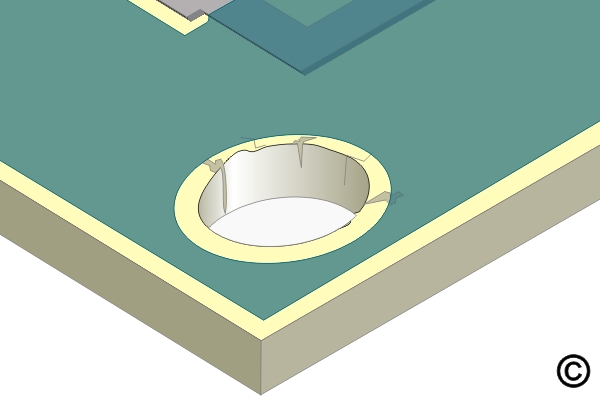
Damaged non-plated hole.
slide 3
Mill away the damaged board base material using the Micro-Drill and ball mill.
slide 4
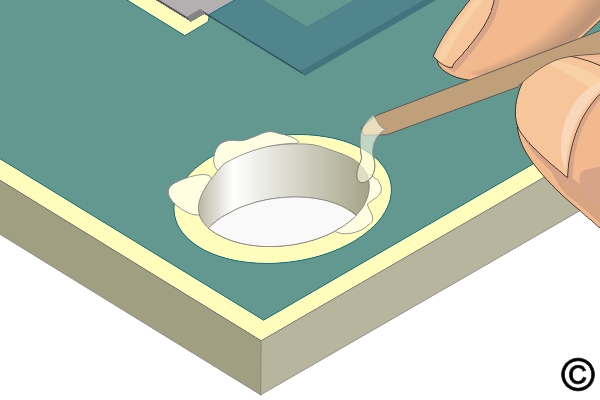
Mix the epoxy. If desired, add a color agent. Coat the area with epoxy up to and flush with the circuit board surface.
SLIDESHOW STARTING

Outline

This method repairs cosmetic defects or minor damage to an unsupported tooling or mounting hole. The hole may have component leads, wires, fasteners, pins, terminals, or other hardware run through it. This repair method uses high-strength epoxy to restore the damaged surface surrounding the hole. This method can be used on single-sided, double-sided, or multilayer circuit boards and assemblies.

Caution: Damaged inner-layer connections may require surface wire adds.

Minimum Skill Level - Advanced

Recommended for technicians with soldering and component rework skills and exposure to most repair/rework procedures, but lacking extensive experience.

Conformance Level - High

This procedure most closely duplicates the physical characteristics of the original, and most probably complies with all the functional, environmental and serviceability factors.

Tools and Materials

Procedure

  1. Clean the area.
  2. Mill away the damaged board base material using the Micro-Drill and ball mill. All damaged base board material and solder mask must be removed. No fibers of laminate material should be exposed at the surface perimeter of the hole. (See Figure 1)
    Note: To see that all damaged material has been removed, flood the area with alcohol or solvent. Damaged internal fibers of the base material will show up clearly.
  3. Remove all loose material and clean the area.
  4. Where needed, apply High-Temperature Tape to protect exposed parts of the circuit board. Tape may be required inside the hole. If epoxy reduces the inside diameter, the hole may have to be re-drilled after the epoxy has cured.
    Note: The circuit board may be preheated before filling the area with epoxy. A preheated circuit board allows the epoxy to flow and level out easily. Epoxy applied to an unheated circuit board may settle below the circuit board surface as the epoxy cures. 
    Caution: Some components may be sensitive to high temperatures.
  5. Mix the epoxy. If desired, add a color agent to the mixed epoxy to match the circuit board color.
  6. Coat the area with epoxy up to and flush with the circuit board surface. A mixing stick may be used to apply and spread the epoxy.
    Note: A slight overfill of epoxy may be desired to allow for shrinkage when the epoxy cures.
  7. Cure the epoxy per Procedure 2.7 Epoxy Mixing and Handling.
  8. After the epoxy has cured, remove the tape.
  9. Use a knife or scraper to scrape off any excess epoxy if needed. Scrape until the new epoxy surface is level with the surrounding circuit board surface. 
    Note: Apply surface coating to match prior coating as required.
  10. Remove all loose material. Clean the area.

Evaluation

  1. Visual and dimensional examination of the reworked area for conformance to drawings and specifications.

Images

QUICK QUESTION?
Have a general inquiry?
Send us a message below.
NEED A FORMAL QUOTE?
Submit a request using our quote form.