Outline
This procedure covers the baking and preheating of printed boards and printed board assemblies to prepare the product for subsequent operations. Included are steps for:
- Baking
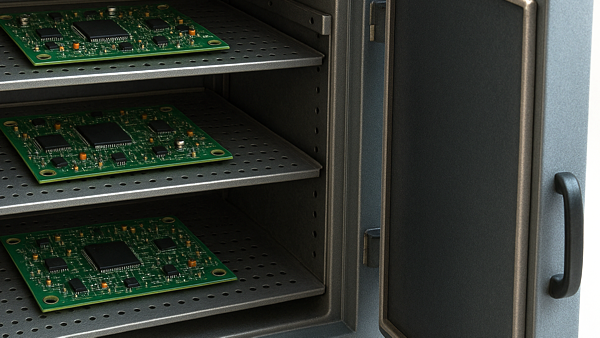
Baking eliminates absorbed moisture. Whenever possible, circuit boards and circuit board assemblies should be baked prior to soldering, unsoldering, and coating operations to prevent blistering, measling, or other laminate degradation. - Preheating
Preheating is used to promote the adhesion of subsequent materials to the board surfaces and to raise the temperature of the circuit board, allowing soldering and unsoldering operations to be completed more quickly. - Auxiliary Heating
Auxiliary heating is the addition of a second source of heat, such as a hot air tool or a second soldering station. A common application is to provide additional heat when removing through-hole components that may have connections to internal power or ground planes. - Thermal Profiles
Ball Grid Array, Chip Scale Packages, and Flip Chip Packages may require the development of "Time Temperature Profiles" to remove or install these devices.
Caution: Baking and preheating procedures must be carefully selected to ensure that the temperature and time cycles do not degrade the product. Environmental conditions must also be carefully considered to ensure that vapors, gases, etc., generated during the heating process do not contaminate the product's surfaces.
Caution: Some manufacturers of ceramic chip capacitors recommend that the Preheat Ramp Rate not exceed 2-4 degrees C/Sec.
Caution: To prevent fluxes or other contaminants from being baked onto the board surface, thoroughly clean the board or assembly prior to baking or preheating.
Minimum Skill Level - Intermediate
Recommended for technicians with skills in basic soldering and component rework, but may be inexperienced in general repair/rework procedures.Conformance Level - High
This procedure most closely duplicates the physical characteristics of the original, and most probably complies with all the functional, environmental and serviceability factors.| Procedure References | |
| 1-0 | 1.0 Foreword |
| 2-1 | 2.1 Handling Electronic Assemblies |
| 2-2 | 2.2 Cleaning Procedures |
Tools and Materials
General purpose cleaner for removing contamination. |
General purpose oven for drying, baking and curing epoxies. |
Nonabrasive, low-linting wipes for cleanup. |
Images