| 5.3 Plated Hole Repair, Inner Layer Connection |
|
Printed Board Type: R
Skill Level: Expert
Conformance Level: Medium
Revision: E
Revision Date: Mar 28, 2001
OUTLINE
 |
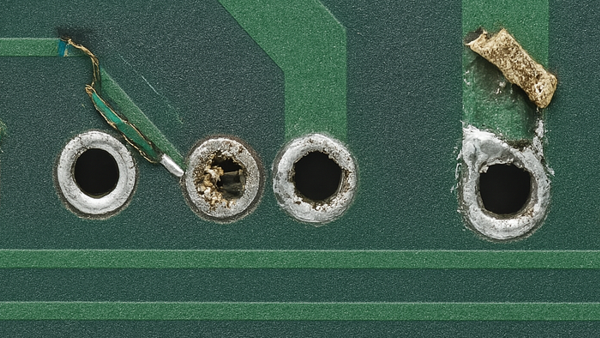
| Damaged Plated Hole with Inner Layer Connection. |
|
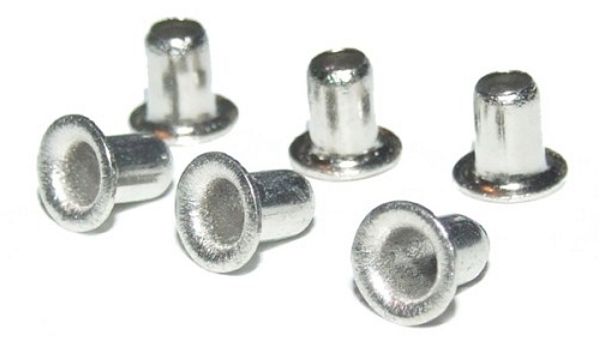
This procedure describes the use of flat set
eyelets for the repair of a through connection that has an inner layer connect.
No surface wire is used. The inner layer reconnect is established by soldering
the barrel of an eyelet to the exposed inner layer and the connection is
encapsulated in high strength epoxy.
CAUTION
This is a complex repair
procedure that demands the proper tools and materials. To expect reliable
results, repair technicians must have a high level of expertise. Use this method
only when alternative methods are unacceptable.
CAUTION
This procedure requires very
accurate control over the location and depth of a milled hole. It is recommended
that a precision drill system be used in combination with a high power stereo
microscope.
| ACCEPTABILITY REFERENCES |
| IPC-A-600 2.0 |
Externally Observable Characteristics |
| IPC-A-600 3.0 |
Internally Observable Characteristics |
| |
| PROCEDURE REFERENCE |
| 1.0 |
Forward |
| 2.1 |
Handling Electronic Assemblies |
| 2.2 |
Cleaning |
| IPC7721 5.3 |
Plated Hole Repair, Inner Layer
Connection |
 |
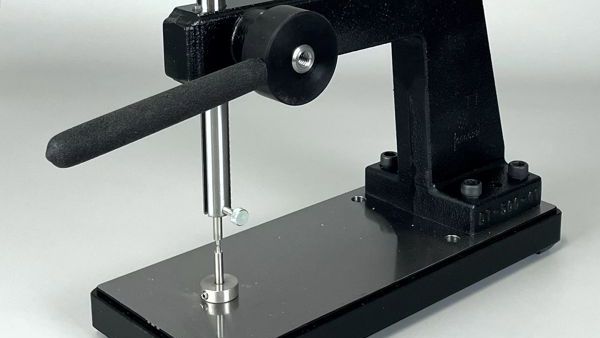
| Figure 1: Precision Drill System shown with circuit board pinned in place. |
|
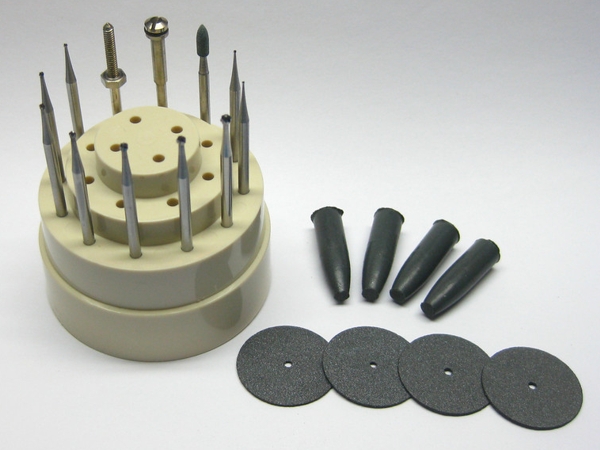
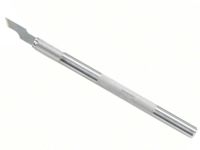
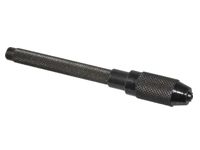
TOOLS &
MATERIALSBall MillsCaliper
Cleaner
End
Mills
Eyelet PressEyelets, Various SizesFlux,
Liquid
Knife
Micro-Drill
SystemMicroscope
Pin Gauges
Plated Hole Repair KitPrecision Drill
System
Setting Form Tool, Various
SizesSetting Anvil, Various
SizesSolder Iron
Solder
Wipes
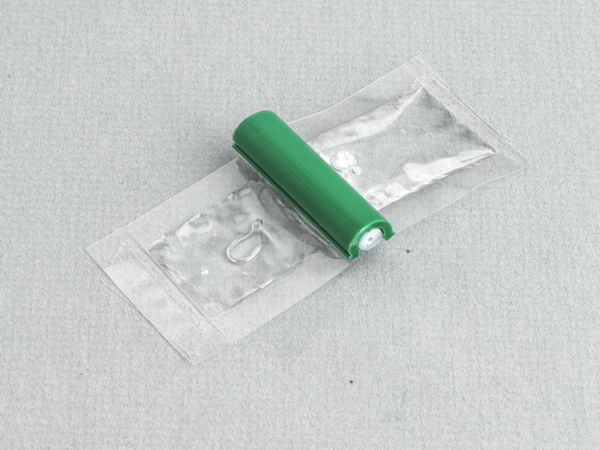
EYELET SELECTION CRITERIA
ID - Inside Diameter
The eyelet inside diameter should be a .075 -
.500 mm (.003"-.020") greater than the component lead diameter.
LUF -
Length Under Flange
The length of the eyelet barrel under the flange
should be .630 - .890 mm (.025" - 035") greater than the thickness of the
circuit board. This added length allows for proper protrusion when setting the
eyelet.
FD - Flange Diameter
The eyelet flange diameter should
be small enough to prevent interference with adjacent lands or
circuits.
OD - Outside Diameter
The clearance hole drilled
through the circuit board should allow the eyelet to be inserted without force
but should not exceed .125 mm (.005") greater than the eyelet outside diameter.
NOTE
Be sure to select an eyelet
meeting the proper criteria. An eyelet with an oversize flange may interfere
with adjacent circuits. An eyelet that is too short will not protrude through
the circuit board for proper setting.
PROCEDURE
-
 |
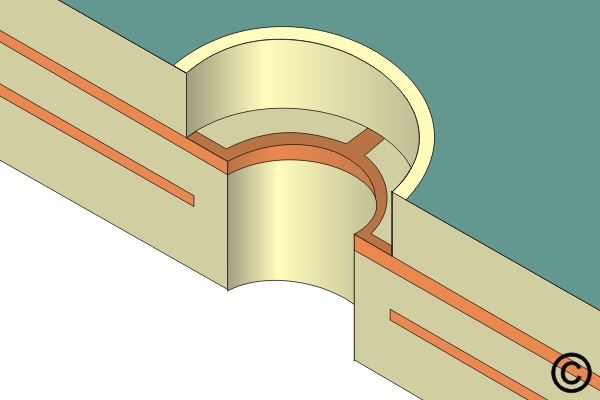
| Figure 2: Mill down to and expose inner layer signal or plane. |
|
Clean the area.
- Select an eyelet using the Eyelet Selection Criteria. Use a pin gauge and
caliper to measure the existing plated hole dimensions.
- Pin the circuit board to the base of the Precision Drill System. (See Figure
1).
- Insert the appropriate ball mill, end mill or drill into the chuck of the
drill press.
- Mill or drill out the hole. The drilled hole should be approximately .030 mm
(0.001") larger than the eyelet O.D. Inspect to ensure no metallic particles or
burrs remain.
-
 |
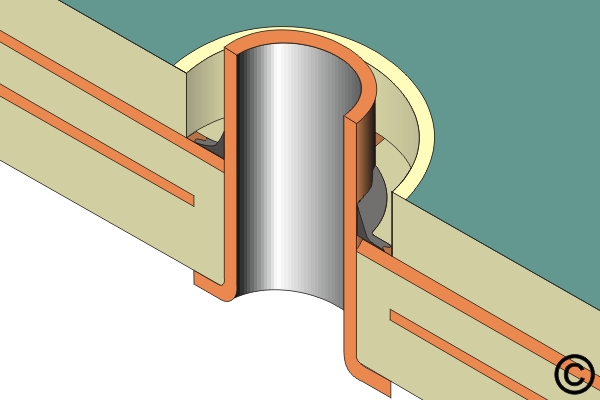
| Figure 3: Solder the eyelet barrel to the exposed inner layer signal or plane. |
|
Select the side of the assembly that will have a counterbored
hole milled into it. This side preferably would have no surface connection.
- Select an end mill approximately .050 - .075 mm (.020" - .030") larger than
the eyelet diameter. Insert into the Precision Drill System and mill down to and
expose the inner layer signal or plane. (See Fig. 2).
CAUTION
Great care must be taken to
control the depth of the milled hole to prevent damage to the inner layer signal
or plane.
-
 |
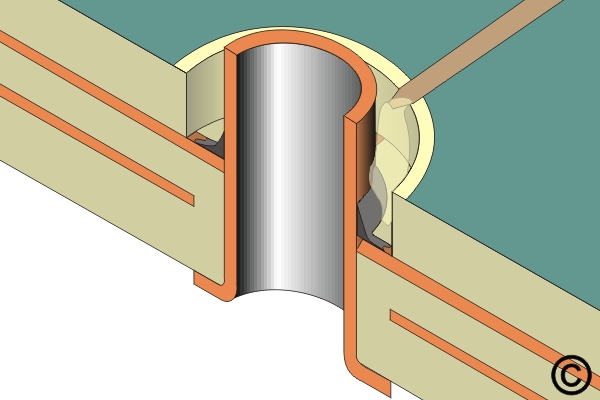
| Figure 4: Fill the milled hole with the epoxy up to, and level with, the surface of the board. |
|
Clean the area.
- Apply a small amount of flux to the exposed signal or plane and tin with
solder.
- Clean the area.
- Insert the eyelet into the hole from the side opposite the milled hole, then
apply a small amount of flux into the milled hole.
- Solder the eyelet to the exposed inner layer signal or plane by applying
heat from a soldering iron to the barrel of the eyelet. (See Figure 3).
-
 |
| Figure 5: Set the eyelet using an Eyelet Press. |
|
Completely remove any solder flux residue by spray rinsing with
cleaner.
- Use a microscope and inspect the solder fillet from the eyelet to the inner
connection and perform electrical tests as required.
- Mix epoxy as required.
- Fill the milled hole with the epoxy up to, and level with, the surface of
the board. (See Figure 4). The epoxy filler material should be free of voids and
air bubbles.
- Cure the epoxy per Procedure 2.7 Epoxy Mixing and Handling.
- Select the proper setting tools and insert them into the eyelet press. (See
Figure 5).
- Turn the circuit board over and rest the eyelet flange on the lower setting
tool.
-
 |
| Figure 6: Eyelet barrel formed flat to circuit board surface. |
|
Apply firm even pressure to form the eyelet barrel. (See Figure
6).
- Install the component lead and solder, if required.
- Clean the area.
EVALUATION
- Visual examination, dimensional requirement of land diameter and inside
diameter.
- Electrical continuity as required.