4.2.1 Conductor Repair, Foil Jumper, Epoxy Method |
|
Printed Board Type: N/A
Skill Level: Advanced
Conformance Level: Medium
Revision: E
Revision Date: Jul 7, 2000
OUTLINE
This method is used on circuit boards to replace damaged or missing circuits on the circuit board surface.
CAUTION
The circuit widths, spacing and current carrying capacity must not be reduced below allowable tolerances.
 |
| Damaged Conductor |
|
TOOLS & MATERIALS
Buffer
Circuit Tracks
Cleaner
Color Agent
Epoxy
Flux, Liquid
Knife
Micro-Drill System
Microscope
Scraper
Solder
Soldering Iron with Tips
Tape, Kapton
Wipes
 |
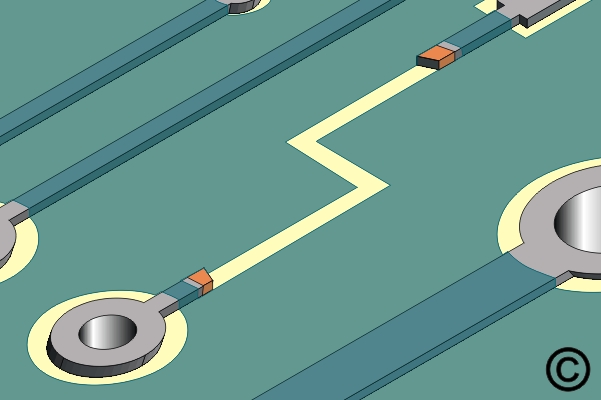
| Figure 1: Scrape off any solder mask or coating from the ends of the remaining circuits. |
|
PROCEDURE
- Clean the area.
- Remove the damaged section of circuit using a knife. The damaged circuit should be trimmed back to a point where the circuit still has a good bond to the PC board surface.
NOTE
Heat can be applied to the damaged circuit using a soldering iron to allow the circuit to be removed more easily.
 |
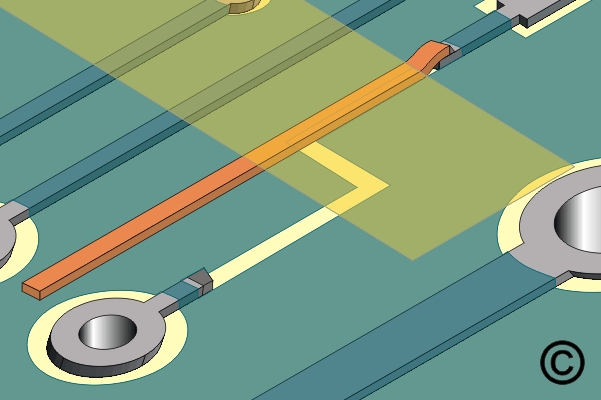
| Figure 2: Place the new Circuit Track in position and hold in place with Kapton tape. |
|
Use a knife and scrape off any solder mask or coating from the ends of the remaining circuit. (See Figure 1).
- Remove all loose material. Clean the area.
NOTE
It is essential that the board surface be smooth and flat. If the base material is damaged see appropriate procedure.
- Apply a small amount of liquid flux to the ends of the remaining circuit. Tin the exposed end of each circuit using solder and a soldering iron.
- Clean the area
- Select a Circuit Track to match the width and thickness of the circuit to be replaced. (See Table 1) Cut a length approximately as needed. The Circuit Track should overlap the existing circuit a minimum of 2 times the circuit width.
Table 1 - Common Circuit Track Sizes
| Part No. |
Thickness |
Width |
| 115-2504 |
.002" |
.004" |
| 115-5206 |
.002" |
.006" |
| 115-5208 |
.002" |
.008" |
| 115-5210 |
.002" |
.010" |
| 115-5312 |
.003" |
.120" |
| 115-5315 |
.003" |
.015" |
| 115-5520 |
.005" |
.020" |
| 115-5530 |
.005" |
.030" |
NOTE
The new circuit may be trimmed from copper sheet.
 |
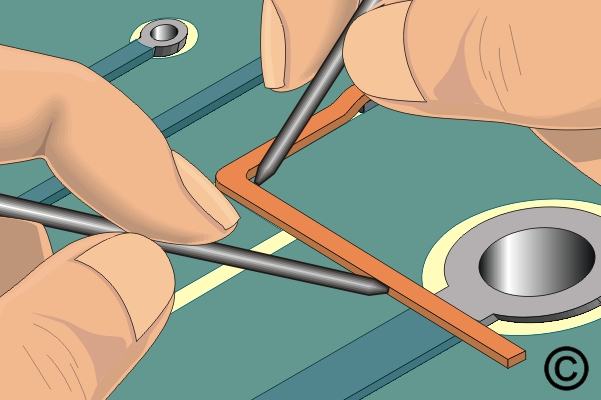
| Figure 3: Bend Circuit Track using 2 wood sticks. |
|
Gently abrade the top and bottom surface of the Circuit Track with a buffer to remove the protective coating.
NOTE
A thin protective coating is applied to the Circuit Track to prevent oxidation.
- Clean the Circuit Track.
- If needed, the ends of the Circuit Track may be tinned with solder prior to lap soldering it in place.
- If the Circuit Track is long or has bends, one end may be soldered prior to forming the new shape. Place the Circuit Track in position. The Circuit Track should overlap the existing circuit a minimum of 2 times the circuit width. The Circuit Track may be held in place with Kapton tape. (See Figure 2).
 |
| Figure 4: Wide circuits that cannot be easily formed may be folded over to produce a sharp bend. |
|
Apply a small amount of liquid flux to the overlap joint.
- Lap solder the Circuit Track to the circuit on the circuit board surface using solder and a soldering iron. Make sure the Circuit Track is properly aligned.
NOTE
If the configuration permits, the overlap solder joint connection should be a minimum of 3.00 mm (0.125") from the related termination. This gap will minimize the possibility of simultaneous reflow during soldering operations. Refer to 7.1 Soldering Basics.
- Bend the Circuit Track as needed to match the shape of the missing circuit. (See Figure 3).
NOTE
Two wood sticks can be used to make sharp bends in the replacement Circuit Track. Use one stick to hold the Circuit Track at the bend location and use the other wood stick to form the shape as needed.
 |
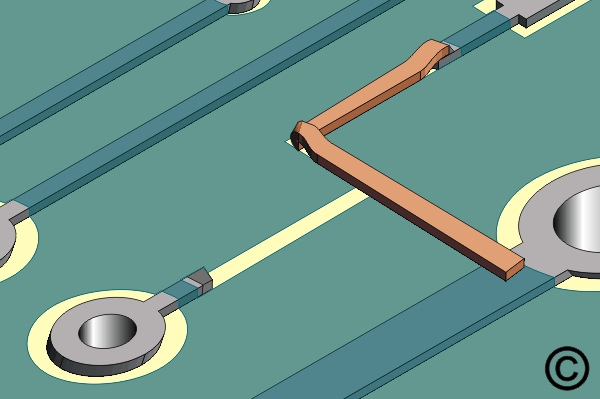
| Figure 5: Form the final shape of the Circuit Track then hold in place with Kapton tape while soldering. |
|
Wide circuits that cannot be easily formed may be folded over to produce a sharp bend. (See Figure 4).
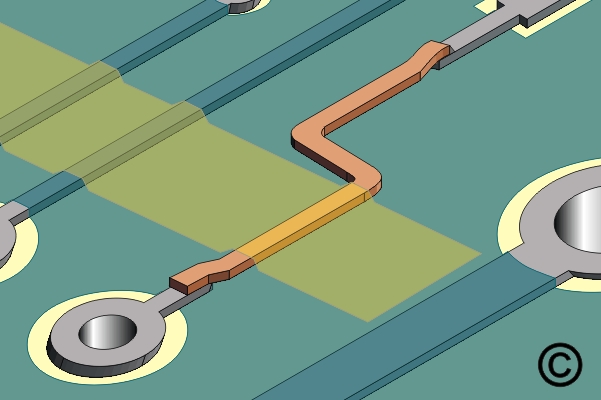
- Form the final shape of the jumper and hold in place with Kapton tape. Lap solder the Circuit Track to the remaining circuit on the circuit board surface using solder and a soldering iron. Make sure the Circuit Track is properly aligned. Remove the Kapton tape used to hold the foil jumped. Clean the area. (See Figure 5).
- Mix the Epoxy. If desired, add color agent to the mixed epoxy to match the circuit board color.
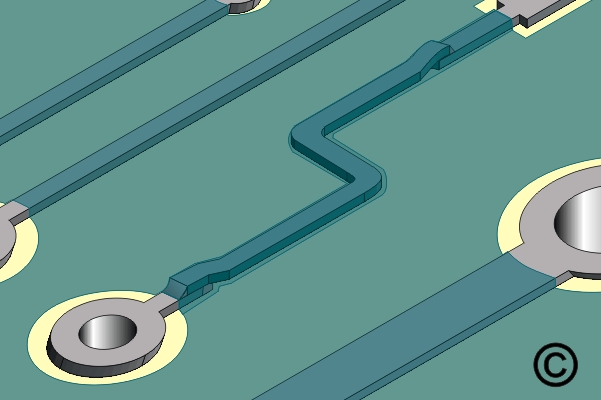
- Coat the top and sides of the Circuit Track with epoxy. The epoxy bonds the Circuit Track to the circuit board surface and insulates it. A wooden stick sharpened at one end may be used to apply and spread the epoxy. (See Figure 6).
 |
| Figure 6: Coat the top and sides of the Circuit Track with epoxy. |
|
Cure the epoxy per Procedure 2.7 Epoxy Mixing and Handling.
CAUTION
Some components may be sensitive to high temperature.
- Apply surface coating to match prior coating as required.
EVALUATION
- Visual examination for alignment and overlap of foil jumper.
- Visual examination of epoxy coating for texture and color match.
- Electrical tests as applicable.
|
Customer Comments
"The technicians at Circuit Technology Center have proven once again that they can handle anything that we throw at them. Thanks again for getting us out of a jam."
A.C. Derby, England
Send us your comments
|