3.4.2 Key and Slot Repair, Transplant Method

Printed Board Type: R/W
Skill Level: Expert
Conformance Level: High
Revision: D
Revision Date: Jul 7, 2000

OUTLINE

Damaged Key Slot At Outlined Area
This method is used to modify or repair a key slot, or other cutout in a printed board or assembly. A replacement piece of matching board material is epoxied into the area needing repair. A new cut is then machined into the repaired area if needed.


CAUTION

Care should be taken to limit the application of epoxy to the specific areas desired and to avoid damage to the conductive patterns, contacts and components.
   

ACCEPTABILITY REFERENCES
IPC-A-600 Externally Observable Characteristics
IPC-A-610 Laminate Conditions
  
PROCEDURE REFERENCE
1.0 Foreword
2.1 Handling Electronic Assemblies
2.2 Cleaning
2.5 Baking and Preheating
2.7 Epoxy Mixing and Handling
IPC7721 3.4.2 Key and Slot Repair, Transplant Method


TOOLS & MATERIALS

Figure 1: Mill out the damaged area using a milling machine or Precision Drill System.

Ball Mills
Base Board Repair Kit
Base Material
Cleaner
End Mills
Epoxy
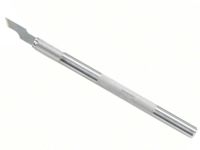
Knife
Micro-Drill System
Milling Machine
Mixing Sticks
Oven
Precision Drill System
Scraper
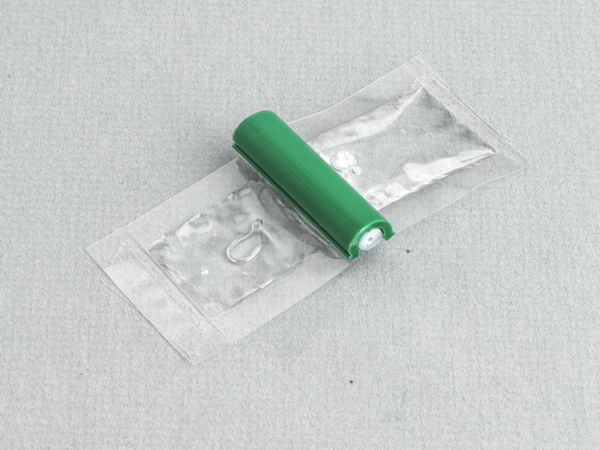
Tape, Kapton
Wipes


PROCEDURE

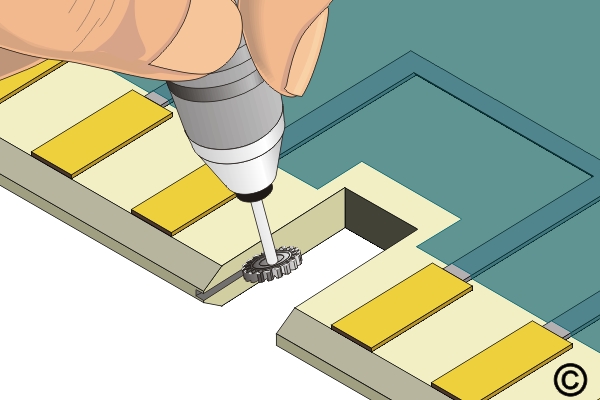
  1. Figure 2: Cut a groove into both sides of the key slot using a Micro-Drill System and carbide saw.
    Clean the area to be filled, including the edges.

  2. Mill out the damaged area using a milling machine or Precision Drill System and carbide end mill. (See Figure 1).

  3. Clean the area.

  4. Install carbide saw into the Micro-Drill System. Set the speed to maximum and machine a groove in the edge of the circuit board where the new base material will be installed. The groove must be centered in the edge to ensure that the new piece will fit properly. The groove width should be approx. 1/3 of the circuit board thickness. The groove depth should be approx. double the groove width. (See Figure 2).

  5. Cut a piece of replacement base board material that is the same thickness and type as the circuit board. The replacement piece should be longer than the length of the slot to allow for ease of handling.

  6. Figure 3: Machine a tongue onto both sides of the replacement base material.
    Install an end mill into the milling machine. Machine a tongue onto both sides of the replacement piece. The dimensions of the tongue should match the size of the milled groove. (See Figure 3).

  7. Where required apply Kapton tape to protect exposed parts of circuit board bordering the prepared area.

  8. Carefully check the fit of the replacement piece and then clean both the replacement piece and the slot. The replacement base material should fit firmly into the slot so that it will not move or fall out when epoxied in place.

  9. Apply Kapton tape to the surface of the circuit board adjacent to the slot. The Kapton tape should protect any adjacent contacts or components.

  10. Figure 4: Insert the replacement piece into the slot.
    Mix the epoxy.

  11. Apply a small amount of epoxy to the edges of the replacement piece and to the inside edges of the slot.

  12. Insert the replacement piece into the slot. Check alignment. Remove excess epoxy. (See Figure 4).

  13. If needed, apply additional epoxy to the edges of the slot. A mixing stick sharpened at the end may be used to apply the epoxy.

  14. Cure the epoxy per Procedure 2.7 Epoxy Mixing and Handling.

    CAUTION
    Some components may be sensitive to high temperature. 

  15. Figure 5: Cut off excess material and file to match edge.
    After the epoxy has cured remove the Kapton tape.

  16. If needed use a knife or scraper and scrape off any excess epoxy.

    NOTE
    If needed, apply additional thin coating to seal any scraped areas. 

  17. Cut off excess length of replacement material and file to match contour of existing edge. (See Figure 5).

  18. Figure 6: Micro-Drill System.
    If a new slot is needed, machine using milling machine and appropriate milling cutter. Use great care to correctly relocate the slot.

  19. Clean the area.

EVALUATION

  1. Visual examination and measurement of key slot location and dimension.

Free Newsletter
The most valuable tool in your repair department is high quality information. Get a subscription to Circuit Rework News.
Customer Comments

"We had never considered sending our rework projects until recently. The cost savings since we started using Circuit Technology Center has been significant. I hope we never have such a massive rework project again, but if we, do you'll be the first to get a call"
N.C. Fort Wayne, IN USA


Send us your comments