3.3.1 Hole Repair, Epoxy Method

Printed Board Type: R/W
Skill Level: Advanced
Conformance Level: High
Revision: D
Revision Date: Jul 7, 2000

OUTLINE

Damaged Hole, Non Plat
This method is used to repair cosmetic defects or minor damage to an unsupported tooling or mounting hole. The hole may have component leads, wires, fasteners, pins, terminals or other hardware run through it. This repair method uses high strength epoxy to restore the damaged surface surrounding the hole. This method can be used on single sided, double sided or multilayer circuit boards and assemblies.


CAUTION

Damaged inner-layer connections may require surface wire adds.


CAUTION

Input Text

ACCEPTABILITY REFERENCES
IPC-A-600 2.0 Externally Observable Characteristics
IPC-A-610 10.0 Laminate Conditions
 
PROCEDURE REFERENCE
1.0 Foreword
2.1 Handling Electronic Assemblies
2.2 Cleaning
2.5 Baking and Preheating
2.7 Epoxy Mixing and Handling
IPC7721 3.3.1 Hole Repair, Epoxy Method


TOOLS & MATERIALS

Ball Mills
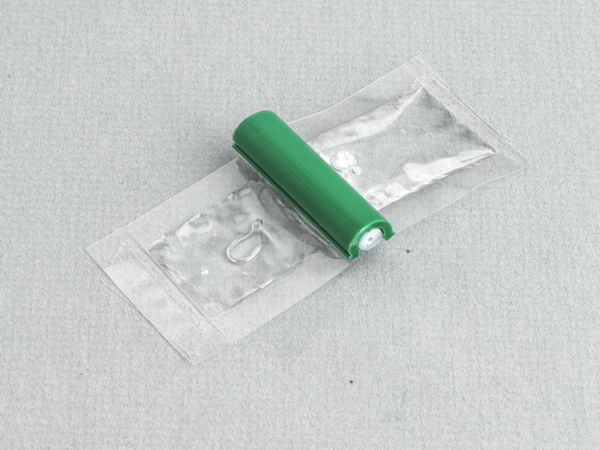
Base Board Repair Kit
Cleaner
Color Agents
Epoxy
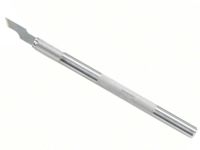
Knife
Micro-Drill System
Mixing Sticks
Oven
Scraper
Tape, Kapton
Wipes

PROCEDURE

  1. Clean the area.

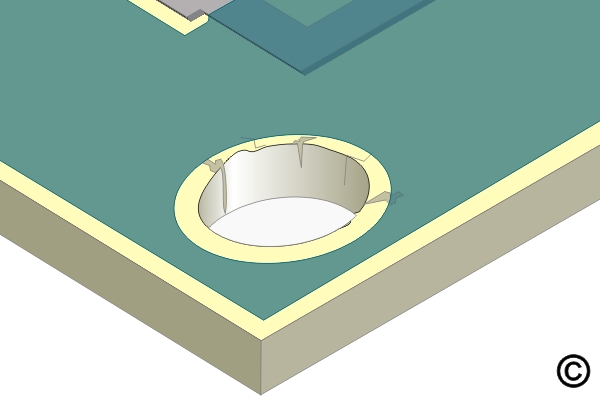
  2. Figure 1: Mill away damaged material with the Micro-Drill and ball mill.
    Mill away the damaged board base material using the Micro-Drill and ball mill. All damaged base board material and solder mask must be removed. No fibers of laminate material should be exposed at the surface perimeter of the hole. (See Figure 1).


    NOTE

    To clearly see that all damaged material has been removed, flood the area with alcohol or solvent. Damaged internal fibers of the base material will show up clearly.  

  3. Remove all loose material and clean the area.

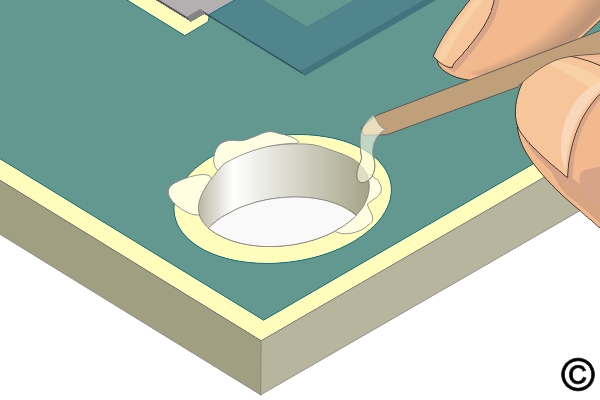
  4. Figure 2: Apply epoxy with a mixing stick sharpened at one end.
    Where needed, apply Kapton tape to protect exposed parts of the circuit board. Tape may be required inside the hole. If epoxy reduces the inside diameter, the hole may have to be redrilled after the epoxy has cured.


    NOTE

    The circuit board may be preheated prior to filling the area with epoxy. A preheated PC Board will allow the epoxy to easily flow and level out. Epoxy applied to an unheated circuit board may settle below the circuit board surface as the epoxy cures.

    CAUTION
    Some components may be sensitive to high temperatures. 

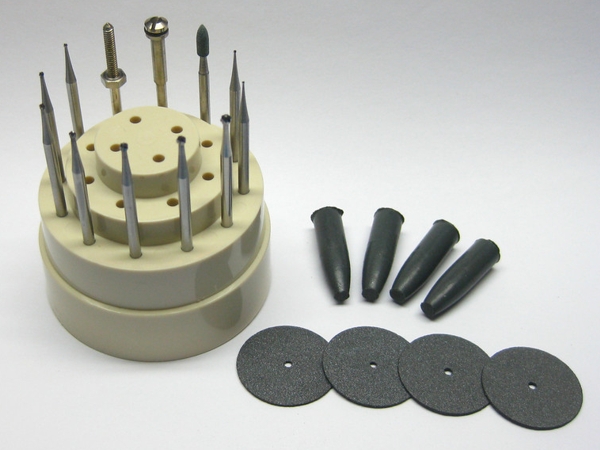
  5. Figure 3: Micro-Drill System.
    Mix the epoxy. If desired, add color agent to the mixed epoxy to match the PC board color.

  6. Coat the area with epoxy up to and flush with the circuit board surface. A mixing stick may be used to apply and spread the epoxy. (See Figure 2).


    NOTE

    A slight overfill of epoxy may be desired to allow for shrinkage when epoxy cures.  

  7. Cure the epoxy per Procedure 2.7 Epoxy Mixing and Handling.

  8. After the epoxy has cured, remove the tape.

  9. If needed, use a knife or scraper and scrape off any excess epoxy. Scrape until the new epoxy surface is level with the surrounding circuit board surface.


    NOTE

    Apply surface coating to match prior coating as required.  

  10. Remove all loose material. Clean the area.  

EVALUATION

  1. Visual examination for texture and color match.

  2. Hole size measurement to specification.

  3. Electrical tests to conductors around the repaired area as applicable.

Free Newsletter
The most valuable tool in your repair department is high quality information. Get a subscription to Circuit Rework News.
Customer Comments

"We're operating on a tight production schedule, with no time to waste. Circuit Technology Center has consistently delivered our boards back to us on time, and sometimes even ahead of schedule. This has helped us stick to deadlines. Thanks to their fast turnaround."
S.L. Fremont, CA USA


Send us your comments