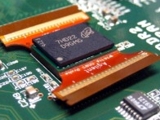
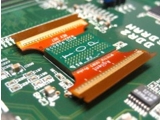
Circuit Technology Center and Keysight Technologies have teamed up to provide the test world with a complete turn-key approach for testing DIMMS directly at BGA component sites.
Keysight Technologies' W2630A series DDR2 BGA probes enable direct probing of embedded memory DIMMs at a ball grid array with Keysight Technologies' logic analyzers and oscilloscopes. Although this dynamic product is available to support Engineers through the test process, it does take some skillful attention.
This procedure provides an overview of installing Keysight Technologies DDR2 DRAM BGA Probes onto circuit board assemblies.
Operator Skills
The DDR2 BGA Probe installation is a challenging process to complete. The engineer or operator must have experience with BGA rework. Reballing of the DDR2 BGA Probe is required for placement onto the circuit board. This process also requires experience and skill.
Equipment
- BGA reballing kit or system for component and probe solder ball attachment.
- Solder paste stencil for circuit board site preparation.
- Hot gas rework station designed for reworking BGA components.
- Microscope with an oblique view for perimeter inspection.
- X-ray inspection system for post-placement inspection.
Here are the steps.
- BGA removal from the circuit board.
The process for safely removing the BGA component is completed using a Hot Gas Rework Station. The circuit board may require additional preparation, such as baking and masking the area adjacent to the rework site. To prevent damage, closely monitor the temperature of the circuit board using thermocouples during the removal cycle.
- Circuit board site cleaning.
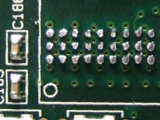
After the component has been safely removed from the circuit board, the component and site must be prepared for the probe placement and the BGA onto the probe. The circuit board and component site cleaning are completed with a vacuum desoldering nozzle that removes all residual solder from the sites.
- Solder ball application to the Probe and component.
The placement of solder balls on the probe and re-balling of the BGA component must be completed before placement on the circuit board. For this process, a specially designed tool for reballing is used along with specific stencils and solder balls to match the probe layout and BGA component.
- Placement of the Probe onto the circuit board.
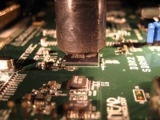
The installation of the Probe onto the circuit board is completed using a Hot Gas Rework System. Solder paste must be applied to the site before placement of the Probe. This process is completed with a solder stencil. The heat application is controlled using a unique repeatable temperature profile for each circuit board.
- Placement of BGA onto the Probe.
The installation of the BGA onto the probe is also completed using the hot gas rework system, which is very similar to the probe placement process. The application of heat is controlled by using a repeatable temperature profile. Solder paste must be applied to the site before placement of the Probe. This process is completed with a solder stencil.
- Inspection to confirm the soldering process.
Like any BGA application, inspecting the solder joints requires an X-ray system. An X-ray of the Probe interface to the circuit board and the BGA component to the Probe is required to inspect for solder bridges, voids, and misalignment. Perimeter inspection can be completed with a microscope or an inspection camera.
Several members of the Circuit Technology Center team contributed to this feature story. Images may be altered or recreated to protect proprietary information.