| March 24, 2010
|
Rework departments often encounter large through-hole components on high-mass circuit boards. The solder fountain system is ideal for this type of rework. With the expanded use of lead-free solders and their higher reflow temperatures, the use of solder fountains has increased.
A solder fountain system can transfer large amounts of heat to a specific area very quickly. A normally laborious and time-consuming procedure with a desoldering tool is completed quickly and with relative ease. However, the strength of the solder fountain system is also its chief danger. Solder can overflow or spatter, which presents the possibility of serious injury. Safety is the primary concern when ...
|
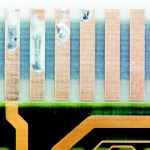
From time to time, gold edge contacts become contaminated with solder. This most often occurs during reflow of an assembly and may be caused by solder spatter or solder paste contamination of the contacts due to improper handling, or other reasons.
Solder contamination is certainly an unacceptable condition because oxidation will ultimately build up on the solder, inhibiting a proper electrical connection to the mating connector. The solder contamination also transforms the normally smooth connector surface into an uneven surface, further compromising the integrity of the ...
|
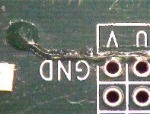
With this ECO, a long row of plated through holes were supposed to be connected to ground in order to properly perform their function. The boards were not properly fabricated, and this long row of holes were not connected to each other, or to ground.
It would seem easy enough to find a ground point and connect the pins once the board was populated, or buss a wire along the row of pads. The customer nixed both of those ideas.
This image shows an in-process view of the burried ground connection and its connection to the line of plated through holes bussed together ...
|
|
|
|
|
Trivia
See the answer below.
|
Quote of the Week
|
|
|