| March 22, 2011
|
The need to attach jumper wires to circuit board assemblies is inevitable. Essentially, jumper wires fall into three basic categories:
1. Those that are considered a component and part of the original design.
2. Those that are added after the original design and fabrication to effect a modification.
3. Those that are added to correct a defect.
The procedures for attaching jumper wires, all told, are fairly extensive, and would ...
|
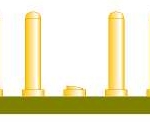
While working with an extremely expensive pin grid array style component, a customer reported that they broke off a pin at the base near the component body. The shoulder of the pin was approximately twice the diameter of the main pin body and approximately .50" (12.7 mm) in length. Is it possible to repair damage to a component like this?
Any repair would have to endure the mechanical stress of insertion, plus the thermal stress of soldering temperatures when the component was soldered back into the circuit board.
Here's the solution. A commercially available pin with the same diameter and gold plating as the original pin, but with a larger ...
|
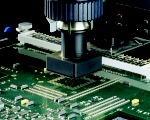
Can every operator handle your BGA rework equally well? In real life, in all but just a few situations, the answer is no. Why is this so? Many factors come into play, including experience, manual dexterity, and sometimes just plain talent. It is critical to have your most "BGA-inclined" operators handle your most demanding BGA rework.
Certainly, there is delicacy involved in making such assignments, to make sure that all operators understand the reasons and know that they are being treated fairly, but that level of personnel management is not the focus of ...
|
|
|
|
|
Trivia
See the answer below.
|
Quote of the Week
|
|
|