| February 24, 2010
|
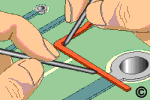
Repairing a damaged conductor with a wire is commonplace, but the repair will shout "Look at me, I've been repaired!." When you want to repair a damaged conductor, but don't want the repair to be evident, try using flat copper ribbon.
After cleaning the area you remove the damaged section of conductor. Then scrape off any solder mask or coating from the conductor ends, and tin the conductor ends with solder.
Then you select a replacement flat copper ribbon circuit to match the width and thickness of the damaged conductor ...
|
Seems like a reasonable request. You've asked your board supplier to apply solder mask only where you want it. Now you're up against a deadline and you hear "we've got a problem".
It could be any number of things. This time it's solder mask covering some part of a circuit board where you don't want it. It's certainly not unusual to find test points, ground pads, or even a component footprint inadvertently covered with solder mask. But, all is not lost! There are several safe and reliable ways to remove solder mask from ...
|
Can you fix a broken corner on a circuit board reliably? Do you consider re-balling ball grid array (BGA) components to be a reliable procedure? Should you attempt to repair a damaged plated hole with an inner layer connection?
Your opinion and experiences with issues such as these are important, since the reliability of most circuit board repair and rework procedures are a matter of industry consensus. So, how do you know if a rework procedure will produce a reliable result?
Most rely on a concept and term known as conformance level. The IPC defines conformance level as an indicator of how closely the repaired or reworked circuit board will be to the original ...
|
|
|
|
|
Trivia
See the answer below.
|
Quote of the Week
|
|
|