8.2.2 Component Removal, Surface Mount Chip Components, Hot Tweezer Method

Printed Board Type: R/F/C
Skill Level: Intermediate
Conformance Level: High
Revision: D
Revision Date: Jul 7, 2000

OUTLINE

Surface Mount Chip Component
This procedure covers one commonly used method for removing surface mount chip components.


NOTE

The goal when removing any component is to remove the component as quickly as possible.


CAUTION - Glued Components

A small dot of epoxy is often used to hold chip components in position during wave soldering processing. Typically these components will be located on the bottom side of a circuit board that has through hole components located on the other side. Whenever you see a board like this, you can generally assume that the chip components will be glued onto the board. You'll need to leave the tip on the component for one or two additional seconds in order to transfer enough heat to overcure or soften the adhesive. If required take a wooden stick or curved tweezers and push the component sideways until the glue joint finally gives way.

ACCEPTABILITY REFERENCES
IPC-A-610 12.0 Surface Mount Assemblies
   
PROCEDURE REFERENCE
2.1 Handling Electronic Assemblies
2.2 Cleaning
2.5 Baking and Preheating
7.1.1 Soldering Basics
7.1.2 Preparation For Soldering
IPC7711 3.3.2 Tweezer Method


TOOLS & MATERIALS

Caliper
Cleaner
Flux, Liquid
Hot Tweezer Tool with Tips
Microscope
Solder
Wipes


NOTE

Determine the direction the part is to be swept off the circuit board surface. Densely packed circuit board assemblies often leave only one direction for the rework tool to follow when sweeping the part off the surface.

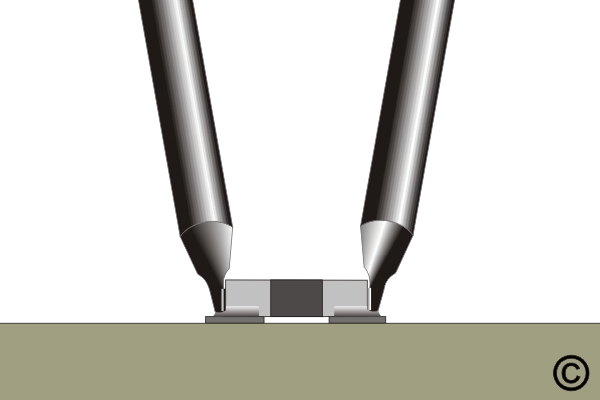
Figure 1: Place the tweezer tips in position. When the solder melts, lift the component off the circuit board.
PROCEDURE

    Preview a Video Clip
     Chip Component Removal (400KB)
     SOT Component Removal (450KB)

  1. Tin the hot tweezer tip.

  2. Apply a small amount of liquid flux to both ends of the component. 

  3. Place the tweezer tips in contact with both ends of the component. When the solder melts, lift the component off the circuit board. (See Figure 1). 

  4. Clean the area.

Chip Capacitors generally have solid color bodies.
A - Stripe;B - Beveled Surface;The striped or beveled end is the "positive" (+) or "anode end".

Free Newsletter
The most valuable tool in your repair department is high quality information. Get a subscription to Circuit Rework News.
Customer Comments

"We had never considered sending our rework projects until recently. The cost savings since we started using Circuit Technology Center has been significant. I hope we never have such a massive rework project again, but if we, do you'll be the first to get a call"
N.C. Fort Wayne, IN USA


Send us your comments