Isolating a Plated Hole From Ground
|

|
|
|
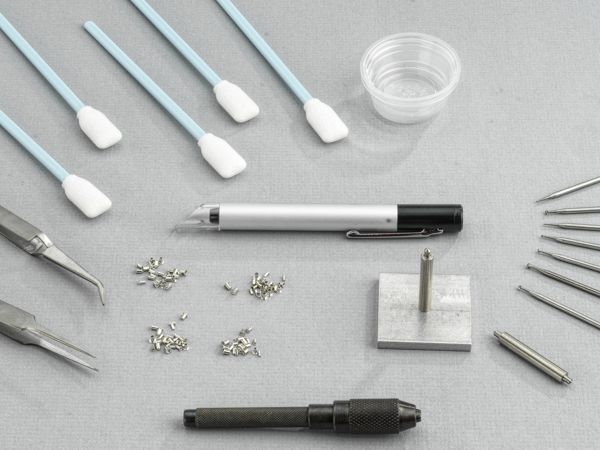
Figure 1: Milling machine used with custom tool to rework a circuit board.
|
Once involved in rework and repair, you quickly realize that all the tools you need to get the job done are just not always available. It occurs to you that unless you're prepared to make the tool yourself or modify an existing one, you won't have it, plain and simple.
Isolating surface pads from ground or other connections is a scenario played out with remarkable frequency in our facility. To make the rework as easy as possible, custom tooling is called for. What can you do about it?
You basically have three options:
- Design and create a completely new, custom tool.
- Apply an existing tool to a completely new or unorthodox application.
- Slightly modify an existing tool to address issues of accessibility (fitting between components, under a component, etc.).
|
|
|
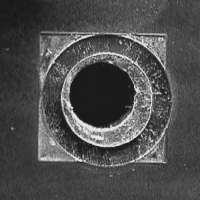
Figure 2: Plated through hole pad reworked with custom hole saw to isolate it from the surface ground plane.
|
The last of the three is the most commonplace in our experience. These modifications -light machining, grinding, narrowing - are mostly performed on existing tools such as end mills, ball mills, bonding tips, soldering and desoldering tips, and knife blades.
In most cases, the tooling requirements are unique from job to job. Therefore you must perform modification of tools immediately to maintain job efficiency. That is why it is so critical to have a level of tool-making/modifying ability in-house.
The nature of rework and repair is such that time is of the essence. In most cases, there is no time to order custom tools. A little creativity and practice, plus some basic grinding or cutting tools, will generally get the job done.
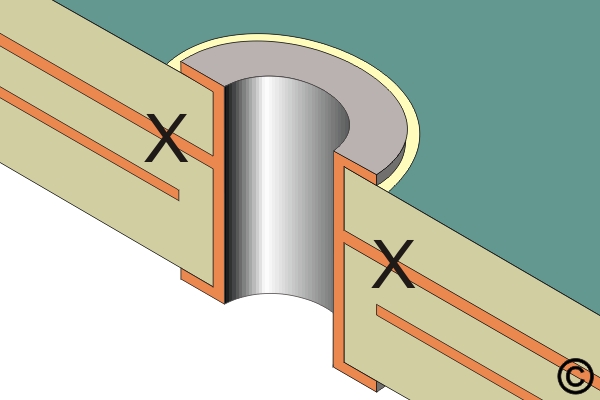
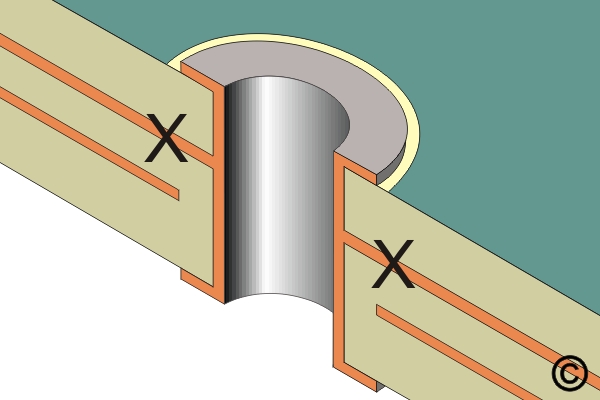
Here's an interesting example of how an existing tool was modified to create a custom "hole saw" - to achieve a specific result. A leading contract manufacturer had received a shipment of assembled circuit boards with a design error. They discovered that the relief for a plated through-hole pad was missing resulting in the pad being connected entirely to the surface ground plane. (See Figure 2.)
Complicating matters was that there were approximately 300 of these boards fully assembled before the error was discovered. Of course, the contract manufacturer was under pressure to deliver good working boards to their customer. To whom could they turn, in a pinch? They called the experts at Circuit Technology Center to develop a rework solution.
After a thorough examination of tools, options, and existing procedures, one of our engineers proposed that a miniature hole saw could be used to isolate this pad from the ground while leaving enough of the pad intact so that the diode installed at this location could be re-soldered in place. The problem was that no hole saw of this small size existed!
A custom cutter was fabricated by machining away a portion of the cutting end of a carbide end mill, resulting in a tool that would cut a circular pad approximately .020" in diameter. (See Figure 2).
This was another example of how a little imagination and creativity in tool adaptation was used to develop a new, cost-effective rework solution and procedure.
Several members of the Circuit Technology Center team contributed to this feature story.
|
|
|
|
|